
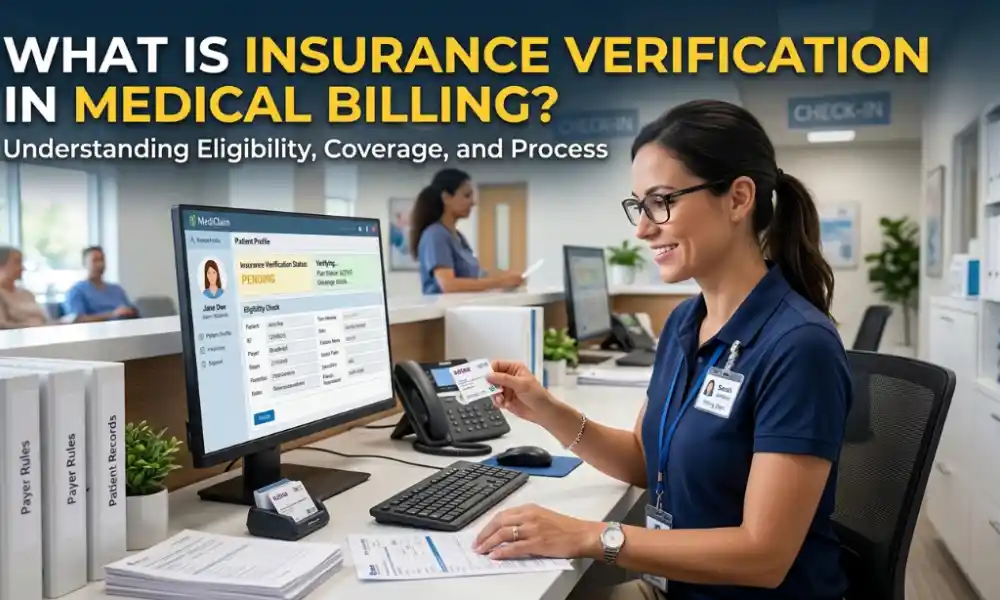
If you have ever gone to a doctor and felt unsure about what your insurance will cover (which happens to most people), you are not alone. Many people feel confused about this.
Before you even see the doctor, the clinic usually checks your insurance in the background. Patients don’t really notice this step.
This is called insurance verification. It may sound small, but it affects your cost, your treatment, and how smooth your visit goes with support from Accura Billing.
Definition of Insurance Verification
Insurance verification means the clinic checks your insurance before giving treatment.
They contact your insurance company to confirm things like:
- If your insurance is active
- What services are covered
- How much the insurance will pay
- How much do you need to pay
In most cases, this happens before your appointment, but sometimes at the front desk when you arrive.
It might seem like a small thing, but it helps a lot to avoid so many frustrating problems later, like wrong bills or claim issues.
Where It Fits in the Medical Billing Process
Insurance verification is one of the first steps in medical billing. It happens before any treatment.
Here is the simple flow:
- Patient schedules an appointment
- Insurance is verified
- Patient comes in
- Treatment is given
- The claim is sent
- Payment is received
If this step is skipped, problems can come up later, like claim rejection or extra costs for the patient.
Key Information Verified Before Treatment
Now, what exactly gets checked during an insurance eligibility check? It’s not just a simple yes-or-no about whether someone has insurance. The verification team looks into several specific details:
– Is the patient’s insurance plan currently active?
– What services are covered under their plan?
– Are there any limits or things not covered?
– Has the patient reached their deductible for this year?
– What is the co-pay?
– Do any services require prior authorization?
– Is the doctor in-network or out?
Each of these details matters. Knowing the co-pay upfront means the front desk can collect the right amount. Knowing whether a specialist visit is covered prevents a surprise bill weeks later. And knowing about prior authorization requirements avoids a situation where the insurance company refuses to pay after the fact.
Role in Revenue Cycle Management (RCM)
Insurance verification is a core part of Revenue Cycle Management, or RCM — the full financial process that healthcare organizations use to track patient care from registration all the way to final payment.
RCM is basically the business side of healthcare. It makes sure that providers get paid for the services they deliver. And without solid insurance verification at the front end, the entire revenue cycle takes a hit.
When verification is skipped or done carelessly, claims get denied. Denied claims mean the provider has to go back, fix the issue, refile — or sometimes just absorb the loss entirely. That’s time, money, and energy wasted on something that could have been avoided with a proper eligibility check upfront.
Strong verification equals a smoother revenue cycle equals a healthier practice. It really is that straightforward.
What Data Is Checked
Let’s look more closely at the specifics of things.
Patient Eligibility
The first thing to do is check whether the patient has an active insurance coverage. This can be verified by the billing staff to ensure that the patient has valid coverage at the time and there have been no changes.
Insurance Plan Details
Not all insurance plans are the same — even from the same company. A patient might have a Gold plan, a Silver plan, an HMO, a PPO, or any number of variations. Each comes with different rules. The verification team confirms exactly which plan the patient is on and how it works for their specific situation.
Coverage Limits
There are usually limits on the number of visits covered each year (such as physical therapy, psychiatric consultations, and specialists). The importance of knowing about such limits is so great since it allows the provider to set realistic expectations for patients. There’s nothing wrong with being told about the 20 physical therapy visits your coverage allows each year before the 21st visit.
Co-pay, Deductible, and Co-insurance
These three concepts tend to puzzle many consumers, yet each of them affects the patient’s out-of-pocket expense:
- Co-pay refers to a fixed expense at each visit; for example, you pay $30 at every visit.
- A deductible is the total cost that a person must pay before getting coverage from an insurance provider.
- Co-insurance is a percentage division; for instance, if the insurer pays 80 percent of the expense, then you are responsible for 20 percent.
Knowing these figures in advance allows the billing team to inform patients clearly and collect the right amounts at the right time — no guessing, no confusion.
Why Insurance Verification Is Important in Medical Billing
Now that we understand the concept of insurance verification, let’s discuss why it is important.
Prevent Claim Denial/Rejection
Claim denial is one of the biggest nightmares for a medical billing service company, which can affect their cash flow significantly, since, apart from the revenue lost, it involves additional administrative efforts to resolve the situation and get compensated.
As research indicates, most claims denial happens because of eligibility issues, meaning that incorrect data, lapses in coverage, and authorization were provided by the patients. And the good thing about it is that all these problems can be avoided through benefits verification in healthcare.
When the verification team does its job thoroughly before treatment, the claims that go out are accurate and complete. Insurance companies have fewer reasons to reject them. The whole billing process runs cleaner and faster.
Ensures Accurate Patient Billing
No one enjoys receiving an unexpectedly hefty bill from their doctor after a medical appointment. It creates confusion and strain, which may severely impact the doctor-patient relationship.
Through insurance verification before appointments, patients are aware beforehand how much they will need to pay. There are no unexpected charges that arise after a procedure has taken place.
Accurate billing builds trust. And when patients trust the billing process, they’re more likely to pay on time — which is a win for the provider too.
Improves Cash Flow for Healthcare Providers
Medical practices run on cash flow. Salaries, rent, equipment, supplies — everything needs to be paid, and paid on time. When claims are denied or delayed because of verification errors, that cash flow gets disrupted.
Proper insurance verification helps ensure that claims are paid faster and with fewer back-and-forth corrections. It’s essentially a quality-control step for the financial health of a medical practice. The more thorough it is, the more predictable and stable the revenue becomes — and that stability matters a lot in a field where margins can be tight.
Enhances Patient Experience
Here’s something that often gets overlooked: insurance verification isn’t just about money — it’s about the patient experience too.
When patients arrive at an appointment knowing exactly what they’ll pay, feeling informed and prepared, the whole experience is less stressful. Healthcare is already emotionally charged. Financial uncertainty on top of that makes everything harder.
A provider that takes the time to verify insurance and communicate clearly is a provider that patients feel taken care of. That builds loyalty. That builds trust. And in a competitive healthcare landscape, that kind of patient experience makes a real difference.
Final Thoughts
Insurance verification usually happens in the background, so patients don’t really think about it. But in reality, it quietly shapes the entire visit experience and directly affects you as a patient, too!
Messy situations are very difficult to handle in clinics. These can be things like claims getting rejected or patients getting insane, unexpected bills. And insurance verification helps to avoid messy situations exactly like that.
So, it’s basically a way to catch problems early instead of fixing them after things go wrong.
When this step is handled properly, everything flows better afterward. People know what to expect, and there’s less confusion all around..