Medical billing can confuse people. There are just so many steps, terms, and systems involved. And there is this one part that gets overlooked a lot! (even though it’s super important). It is payment posting in medical billing.
You can think of it like this: You’ve done all the hard work. Patient visits, coding, and sending claims. Now money starts coming in. Great, right? But if you don’t record those payments properly, things can quickly turn messy.
That’s where payment posting comes in.
It helps healthcare providers:
- Track who paid and who didn’t
- Avoid billing mistakes
- Keep finances clear and organized
- Make better business decisions
Without proper posting, it’s like running a business with no idea where your money is going. Not fun at all!
What Is Payment Posting in Medical Billing?
So, what is payment posting in medical billing exactly?
In simple words, it means recording the payments received from insurance companies and patients into the billing system.
When a payment comes in, someone needs to:
- Check how much was paid
- Match it with the correct patient account
- Update the system
- Adjust any differences (like write-offs or patient responsibility)
It’s kind of like updating your bank account after you get paid, but for a medical office.
There are usually two types of payments:
- Insurance payments
- Patient payments
Each one needs to be handled carefully so the records stay accurate.
Types of Payments (Insurance vs Patient Payments)
Let’s break this down in a very simple way.
1. Insurance Payments
Once an insurance company finishes processing a claim, it will send over the payment along with a breakdown of the details. This document is usually called an ERA if it’s digital, or an EOB if it’s on paper
This document shows:
- What was billed
- What was paid
- What was denied
- What the patient still owes
2. Patient Payments
These are payments made directly by the patient. This could be:
- Copay
- Coinsurance
- Deductible
- Full payment (if no insurance)
Both types are important, and both are part of the payment posting process in medical billing.
Simple explanation of payment posting
Payment posting is simply recording payments correctly. But even though it sounds easy, it requires attention to detail. One small mistake can cause billing errors later.
Where it fits in the revenue cycle
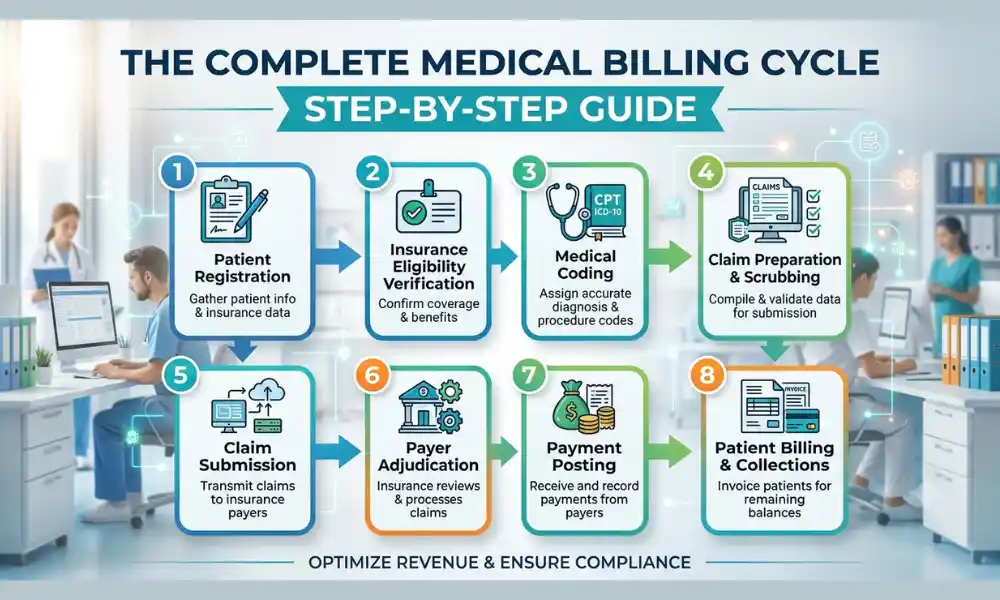
Payment posting comes after claim submission and payment receipt. It’s a key step in the revenue cycle because it confirms that money has actually been collected.
Difference between ERA (Electronic Remittance Advice) & EOB
ERA is digital and faster
EOB is paper-based and slower
Both show payment details, but ERA is easier to process automatically.
Manual vs automated posting
Manual posting: A person enters payment details by hand
Automated posting: The system reads ERA files and updates records automatically
Automation saves time, but manual checks are still important.
How Payment Posting Works in the Revenue Cycle
Now let’s look at how everything flows step by step.
The payment posting process in medical billing is not just one action—it’s a series of steps that keep everything running smoothly.
Here’s why this part matters so much:
- It helps track incoming money clearly
- It shows which claims are paid, denied, or pending
- It updates patient balances correctly
- It helps avoid billing errors later
Let’s walk through how this actually works, step by step, so you can see the whole process in action.
Receiving Payment from Insurance Companies
First, payments arrive from insurance companies.
These usually come with:
- ERA (electronic file)
- EOB (paper document)
The billing team reviews these to understand:
- How much was paid
- If anything was denied
- What adjustments are needed
This step is like opening your paycheck and checking if everything looks right.
Posting Payments into Billing Systems
This is the step where things become real. It is where payments are actually recorded inside the system. After receiving payment details (through ERA, EOB, or patient payment), the next job is to enter that information into the billing software. This step is at the core of how to do payment posting in medical billing.
But it’s not just about typing numbers. There’s a process behind it.
First, the person posting the payment needs to:
- Find the correct patient account
- Match the payment with the correct claim
- Check the billed amount vs paid amount
Then, they carefully enter:
- Payment amount
- Date of payment
- Insurance or patient details
- Any reference numbers
If it’s an ERA (electronic file), some systems can post payments automatically. This is called automated posting. It saves time and reduces manual work.
But even with automation, human review is still important. Why? Because:
- Not all payments match perfectly
- Some claims may be partially paid
- Some may be denied or need correction
In manual posting, everything is entered by a person. This takes more time, but it allows better control and accuracy if done carefully.
A small mistake in this step can cause big issues, like:
- Posting payment to the wrong patient
- Showing incorrect balances
- Missing important adjustments
- These inaccuracies often lead to avoidable claim rejections that stall your practice’s cash flow.
That’s why attention to detail is very important during this stage of the payment posting process in medical billing.
In simple terms, this step is like updating your financial records. If you do it right, everything stays clear. If not, confusion starts building up quickly.
Adjustments, Write-Offs, and Patient Responsibility
This is the step where we have to go into a little detail. But you don’t have to worry. Because we will still keep it easy and simple. When a claim is processed, the insurance company usually doesn’t pay the full amount that was billed. And that’s completely normal. This is where adjustments, write-offs, and patient responsibility come in.
Let’s break it down:
Adjustments mean changing the billed amount based on the insurance rules. For example, if a doctor charges $200 but the insurance only allows $150, then the extra $50 is removed as an adjustment.
Now, write-offs are the amounts that the provider agrees not to collect. These are not mistakes. They are part of the contract between the provider and the insurance company. Once written off, that amount is gone and cannot be billed to the patient.
Then comes patient responsibility. This is the part the patient has to pay. It can include:
- Copay (fixed amount paid during visit)
- Deductible (amount patient pays before insurance starts paying)
- Coinsurance (a percentage of the cost)
During the payment posting process in medical billing, it’s very important to assign these correctly. If you make a mistake here:
- Patients might get wrong bills
- The practice might lose money
- Or it could create confusion and complaints
So this step is not just about numbers. It’s about accuracy and fairness, too.
Reconciliation and Reporting
Now this step is easily the most important one!.
After all payments are posted, you can’t just assume everything is correct. You need to double-check. That’s exactly what reconciliation is.
Reconciliation means comparing the payments you posted in the system with the actual money received in the bank.
If your system says you received $5,000 today, your bank account should also show $5,000. If it doesn’t match, something is wrong.
This step helps to:
- Catch missing payments
- Find duplicate entries
- Detect posting errors
- Prevent financial losses
Some problems can seem very small. But even the smallest mismatch can cause disasters later on, and then they are also hard to get rid of.
Now let’s talk about reporting.
Once everything is checked, reports are created. These reports give a clear picture of the financial health of the practice.
Some common reports include:
- Daily payment reports
- Insurance vs patient payment reports
- Outstanding balance reports
- Denial and adjustment reports
These reports help answer important questions like:
- How much money are we making?
- Are we collecting payments on time?
- Which insurance companies are paying less or delaying?
- Where are we losing money?
This is why reporting is a key part of payment posting in medical billing. Those raw numbers become something way more valuable for you.
In simple words, it makes sure everything is correct, and reporting helps you understand what those numbers actually mean and how you can understand them.
Step-by-step workflow
Here’s a simple version of the full process:
- Receive payment (ERA/EOB or patient payment)
- Review payment details
- Post payment into the system
- Apply adjustments
- Assign patient responsibility
- Reconcile accounts
- Generate reports
That’s the full payment posting process in medical billing in a clean and easy flow.
Final Thoughts
So now you can see why payment posting in medical billing is such a big deal.
It’s not just data entry. It’s what keeps the financial side of a healthcare practice working properly.
When done right, it helps:
- Avoid errors
- Improve cash flow
- Keep patients informed
- Make the whole billing process smoother
And if you were wondering again what payment posting is in medical billing, just remember this:
It’s the step where payments are recorded, checked, and organized so everything makes sense financially.
If you ever plan to work in medical billing, learning how to do payment posting in medical billing correctly will give you a strong advantage.
It might seem small, but it plays a huge role behind the scenes.