
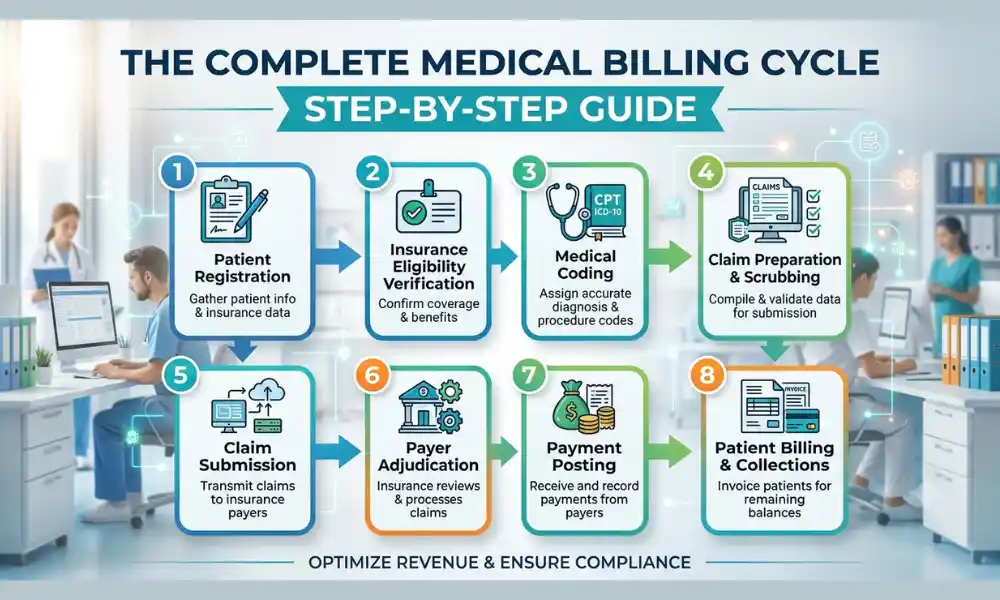
The medical billing cycle is the entire process your practice follows to get paid for the services and care you provide. This cycle begins the moment a patient registers for an appointment and continues until the claim is fully paid and resolved. In the process, your team handles everything, including insurance verification, documentation, and submission. This cycle takes 30-45 days when everything goes smoothly.
What Is the Medical Billing Cycle?
Getting paid for patient care isn’t as simple as sending a bill and waiting. There’s a whole process behind it, with a lot of moving parts. Miss one, and the payment gets delayed or denied. Please make sure you understand the process if you want to make it faster and more predictable. Here’s the step-by-step process:
Definition of the Medical Billing Cycle
The medical billing cycle is the full sequence of steps a healthcare practice follows to bill a patient’s insurance and get paid for the care that was provided. It starts the moment a patient books an appointment and doesn’t close out until every dollar owed has actually landed in the practice’s account.
Why the Medical Billing Cycle Matters for Healthcare Providers
Every broken link in this cycle costs money. Anything like a missed eligibility check or a wrong code can turn a clean claim into a denied one. Practices that understand the full cycle, not just their piece of it, catch problems before they become lost revenue.
Medical Billing Cycle vs Revenue Cycle Management (RCM)
People use these terms interchangeably, but they’re not quite the same thing. The billing cycle is the claim-by-claim process and registration through payment. Revenue cycle management is the bigger picture: the strategy, technology, and oversight that keeps every billing cycle running efficiently across the whole practice. We’ll break this distinction down further later in the guide.
Medical Billing Cycle Workflow at a Glance
Eleven steps make up the full billing cycle. Some happen before the patient even walks in. Others happen weeks after they’ve left. Here’s how it works:
End-to-End Medical Billing Workflow
Here’s the full cycle in order:
- Patient registration and demographic collection
- Insurance eligibility verification and prior authorization
- Medical coding (ICD-10, CPT, HCPCS)
- Charge entry and claim creation
- Claim scrubbing and validation
- Claim submission to insurance companies
- Insurance claim adjudication
- Payment posting and reconciliation
- Denial management and appeals
- Patient billing and payment collection
- Accounts receivable (A/R) follow-up
Each step feeds the next. A mistake early in the cycle, like a typo in a patient’s insurance ID, doesn’t just cause one problem; it ripples all the way through to the A/R stage months later.
Step 1 – Patient Registration and Demographic Collection
Collecting Accurate Patient Information
This is where the whole cycle starts, and it’s more important than most front desks treat it. Collect the patient’s basic information carefully at check-in, including their name, date of birth, address, insurance ID, and policyholder details. If any of it is incorrect, the claim may run into issues later.
Common Registration Errors That Lead to Claim Denials
Misspelled names, transposed policy numbers, outdated addresses, and wrong dates of birth are some of the most common, but the most preventable reasons claims bounce back. None of these are complicated errors. They’re just small ones that get expensive fast.
How to make Patient Registration more accurate
Double-check ID and insurance at every visit. Confirm details out loud with the patient rather than assuming last visit’s file is still correct. A quick double-check at check-in saves a much longer fix weeks later.
Step 2 – Insurance Eligibility Verification and Prior Authorization
Why Insurance Verification Is Essential
Confirming coverage before the appointment, not after, is what keeps a claim from getting denied for something entirely avoidable. It also tells the patient upfront what they’ll owe, which cuts down on billing disputes later.
Checking Benefits, Deductibles, and Copays
This step means confirming what’s actually covered, what the patient’s deductible looks like so far this year, and what their copay or coinsurance will be. Getting this right before the visit means no surprises for the patient or the practice.
When Prior Authorization Is Required
Certain procedures, imaging, and specialist referrals need payer approval before they happen. Skipping this step is one of the fastest ways to get a claim denied outright, regardless of how clean the rest of it is.
Common Insurance Verification Mistakes
Relying on outdated eligibility data, not rechecking coverage for returning patients, and missing authorization requirements for newer procedure codes are the most frequent slip-ups here. Our team walks through these gaps as part of insurance verification when practices bring us in to clean up their front-end process.
Step 3 – Medical Coding (ICD-10, CPT & HCPCS)
Assign the Right Diagnosis Codes
The ICD-10 codes tell the insurance payer the reason each patient was seen. Their diagnosis should be coded very accurately and specifically because if the code is too general or doesn’t match the services provided, there’s a much higher chance the claim will be denied.
CPT and HCPCS Procedure Coding
CPT codes describe what was actually done during the visit, and HCPCS codes cover supplies, equipment, and services that CPT doesn’t. These two systems work together to paint the full picture of the encounter for the payer.
How Coding Errors Affect Reimbursement
A single wrong digit in a code can mean underpayment, denial, or worse, an audit flag. Coding isn’t just clerical work. It’s the step that determines whether the practice gets paid what it actually earned.
Tips for Coding Accuracy
Keep coders current on annual code set updates, cross-check documentation against codes before submission, and don’t let coding staff work from memory on rarely-used codes. Accurate, specialty-specific medical coding is one of the biggest levers a practice has for reducing denials.
Step 4 – Charge Entry and Claim Creation
What Is a Charge Entry?
Charge entry is where the coded services get translated into dollar amounts and loaded into the billing system to build the actual claim. It’s the bridge between clinical documentation and the financial side of the practice.
How Charges Are Entered Into Billing Software
- Enter the correct CPT and ICD-10 codes.
- Apply the right fee schedule.
- Add any required modifiers.
- Review the claim before submission.
- Don’t rely only on billing software.
Common Charge Entry Errors
- Duplicate claim entries
- Incorrect fee schedules
- Missing modifiers
- Mismatched service units
These are some of the most common errors, and they’re easy to miss when claim volumes are high and your staff is trying to work quickly.
Step 5 – Claim Scrubbing and Claim Validation
What Is Claim Scrubbing?
Claim scrubbing is the last review of your claim before it’s sent to the payer. The software checks for issues like missing information and coding mismatches.
How Clearinghouses Detect Errors
Clearinghouses run claims against payer-specific rule sets, flagging anything that doesn’t match expected formatting, coding logic, or coverage requirements. A claim that fails scrubbing gets sent back before it ever hits the payer’s desk.
Benefits of Clean Claims
Clean claims get paid faster, with fewer follow-up calls. Your staff also spends way less time chasing denials. This is one of the clearest ways a practice can shorten its whole reimbursement timeline.
Common Claim Validation Errors
The following are some of the most common claim verification errors that are very easy to miss:
- Incomplete patient details
- Incorrect or invalid codes
- Provider NPI mismatches
- Formatting and data entry errors
Step 6 – Claim Submission to Insurance Companies
Electronic vs Paper Claim Submission
Electronic claims move through clearinghouses in a matter of hours and get processed much faster. Paper claims can still work, but they are not common anymore because they take a lot more time and there is a higher error rate.
CMS-1500 vs UB-04 Claim Forms
You’ll usually come across two claim forms. For professional services, like a physician office visit, you’ll use the CMS-1500. If you’re billing for a hospital or another facility, you’ll use the UB-04 instead. Using the wrong form for the setting is an automatic rejection.
How Insurance Companies Receive Claims
Most claims arrive through a clearinghouse that routes them directly into the payer’s system. From there, the payer’s own processing engine takes over to begin adjudication.
Claim Submission Tips
Submit as soon as the claim is scrubbed clean; don’t let claims sit in a queue, and track submission confirmations so nothing falls through the cracks. Timely submission alone prevents a whole category of denials tied to filing deadlines.
Step 7 – Insurance Claim Adjudication
What Happens During Claim Adjudication?
This is where the payer reviews your claim. They’ll verify the patient’s coverage, review whether the services are covered, and decide how much they’ll pay based on their policies.
Accepted vs Rejected vs Denied Claims
A rejected claim never made it through the payer’s system, while a denied claim did. The first usually needs to be fixed and resubmitted. The second may need to be corrected or appealed.
Explanation of Benefits (EOB)
Patients often mistake the EOB for a bill, but it isn’t one. It simply shows what the insurance paid and what the patient may still be responsible for.
Electronic Remittance Advice (ERA)
Instead of an EOB, providers receive an ERA from the payer.. It details exactly how much was paid, what was adjusted, and why, and it’s what billing teams use to post payments accurately.
Step 8 – Payment Posting and Reconciliation
Recording Insurance Payments
Once the ERA arrives, payments get posted against the original claim in the billing system. This step confirms exactly what was paid versus what was billed.
Posting Patient Payments
Copays, deductibles, and coinsurance collected from the patient also get logged here, whether that payment happened at check-in or after the EOB went out. Keeping this accurate matters just as much as the insurance side.
Reconciling Payments With Claims
Every posted payment gets matched back against the original claim to confirm nothing was missed or misapplied. Payment posting sounds like a small administrative task, but it’s actually where a lot of underpayments first get noticed.
Identifying Underpayments
Comparing what was paid against the contracted rate with the payer is the only way to catch systematic underpayment. Left unchecked, small underpayments across hundreds of claims add up to real lost revenue over a year.
Step 9 – Denial Management and Appeals
Common Reasons Medical Claims Are Denied
Missing authorization, coding errors, eligibility issues, and filing deadline misses account for most denials. Almost all of them trace back to a step earlier in the cycle, not the payer being difficult.
How to Appeal Denied Claims
An appeal means correcting the issue, gathering supporting documentation, and resubmitting within the payer’s appeal window. The tighter and better-documented the appeal, the faster it tends to get resolved.
Ways to prevent future claim denials
Don’t just fix denials one by one. Every time, notice the reasons for these denials so you can find patterns and avoid them down the road.
Denial Management Best Practices
A few simple habits can make denial management much more effective:
Assign one person to manage denials.
Appeal denied claims on time.
Review denial trends every month.
Address the root cause of recurring denials.
A strong denial management process can help improve cash flow and reduce repeat billing issues.
Step 10 – Patient Billing and Payment Collection
Sending Patient Statements
The next step is billing the patient for any balance insurance didn’t cover. A simple, easy-to-read statement can go a long way toward getting paid faster.
Managing Patient Balances
Keeping track of what each patient owes and when it’s due keeps cash flow predictable. It also makes it easier to catch accounts falling behind before they become a real problem.
Payment Plans and Online Payments
Offering payment plans and easy online payment options removes a lot of friction. Patients pay faster when it takes thirty seconds instead of writing a check and mailing it.
Improving Patient Collections
Send statements quickly. Follow up on unpaid balances.
Make it easy for patients to pay.
Review outstanding accounts regularly.
Step 11: Accounts Receivable (A/R) Follow-Up
What Is Medical Accounts Receivable?
A/R is simply the money owed to the practice that hasn’t been collected yet. Every day a claim sits unpaid, it’s aging in A/R.
Following Up on Unpaid Claims
This means checking claim status, calling payers, and pushing stalled claims forward. Waiting around for a claim to resolve on its own is how revenue quietly disappears.
Reducing Days in A/R
Time matters in medical billing. A claim that’s paid in 30 to 45 days is in much better shape than one that’s been sitting for months.
AR Recovery Best Practices
Work the oldest claims first. Set clear follow-up timelines. Don’t let anything sit untouched past 90 days. Good A/R management helps you recover payments that might otherwise be delayed or overlooked.
Common Medical Billing Mistakes That Delay Payments
Here are some of the mistakes that happen a lot:
Incorrect Patient Information
Even one wrong digit in a policy number can send a clean claim straight to rejection.
Coding Errors
Outdated or mismatched codes are one of the most common reasons claims get denied, across every specialty.
Missing Prior Authorization
Skip this for a procedure that needs it, and the claim gets denied automatically. No exceptions.
Duplicate Claims
Sending the same claim twice, usually by accident, causes confusion and delays that didn’t need to happen.
Late Claim Submission
Every payer has a deadline. If you miss the deadline, even your valid claims can go unpaid.
No Follow-Up
Claims that get sent and then forgotten are exactly how revenue slips away quietly.
Medical Billing Cycle vs Revenue Cycle Management (RCM)
Key Differences Between Medical Billing and RCM
Medical billing is the day-to-day work, claim by claim. RCM is the bigger strategy above it. It covers scheduling, registration, reporting, and long-term financial performance.
Why Healthcare Practices Need Both
Billing keeps individual claims moving. RCM keeps the whole financial engine of the practice healthy. Without both, there are gaps. Either in daily execution or in the bigger picture.
Which Process Impacts Revenue the Most?
Both matter. But RCM tends to have the bigger long-term impact. It’s what catches patterns, like a recurring denial issue, before they quietly drain revenue month after month. Full-service RCM is where that kind of oversight actually happens.
How Technology Is Improving the Medical Billing Process
Technology has made the medical billing process much easier than it used to be. Here are some of the ways how:
AI in Medical Billing
AI now handles a lot of the repetitive checking work. It flags missing fields. It predicts which claims might get denied before they’re even sent. It’s not replacing billing staff. It’s just clearing the noise so people can focus on what actually needs a human eye.
Automation and Electronic Claims
Automated claim checks and electronic submission have made the whole process much faster than the old paper-based way of doing things.
EHR and EMR Integration
When billing software pulls directly from the EHR, there’s a lot less manual re-typing. And less re-typing means fewer mistakes.
Predictive Analytics for Denial Prevention
Some billing systems use modern technology and help you avoid problems before a claim is even submitted. This means you don’t have to wait for the denial to start fixing issues.
FAQs
Who handles the medical billing cycle at a practice?
Usually it’s front desk staff, billers, and coders working together. Some practices handle it all in-house. Others outsource it to a billing company to save your time and avoid errors.
How long does the medical billing process take?
A clean claim usually takes 30 to 45 days. Issues can cause delays.
What causes medical claims to be denied?
The most common causes are coding errors, missing prior authorization, eligibility problems, and late submission.
What is claim adjudication?
It’s the payer’s review process. They verify the patient’s coverage and determine how much they’ll pay.
Final Thoughts
The medical billing cycle only works when every step is treated as connected. Not as eleven separate tasks handled by eleven separate people who never talk to each other. Clean registration protects clean coding. Clean coding protects the claim. And steady A/R follow-up is what actually turns all that effort into money in the bank. For practices that don’t have the time or staff to manage all of this in-house, working with a dedicated billing partner often closes that gap.